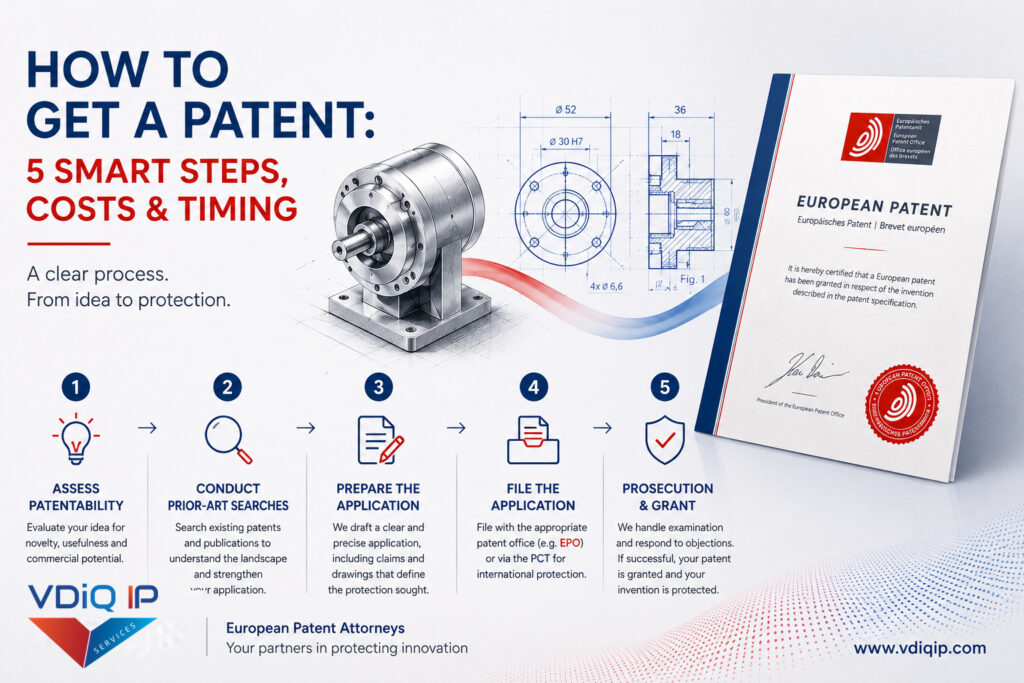
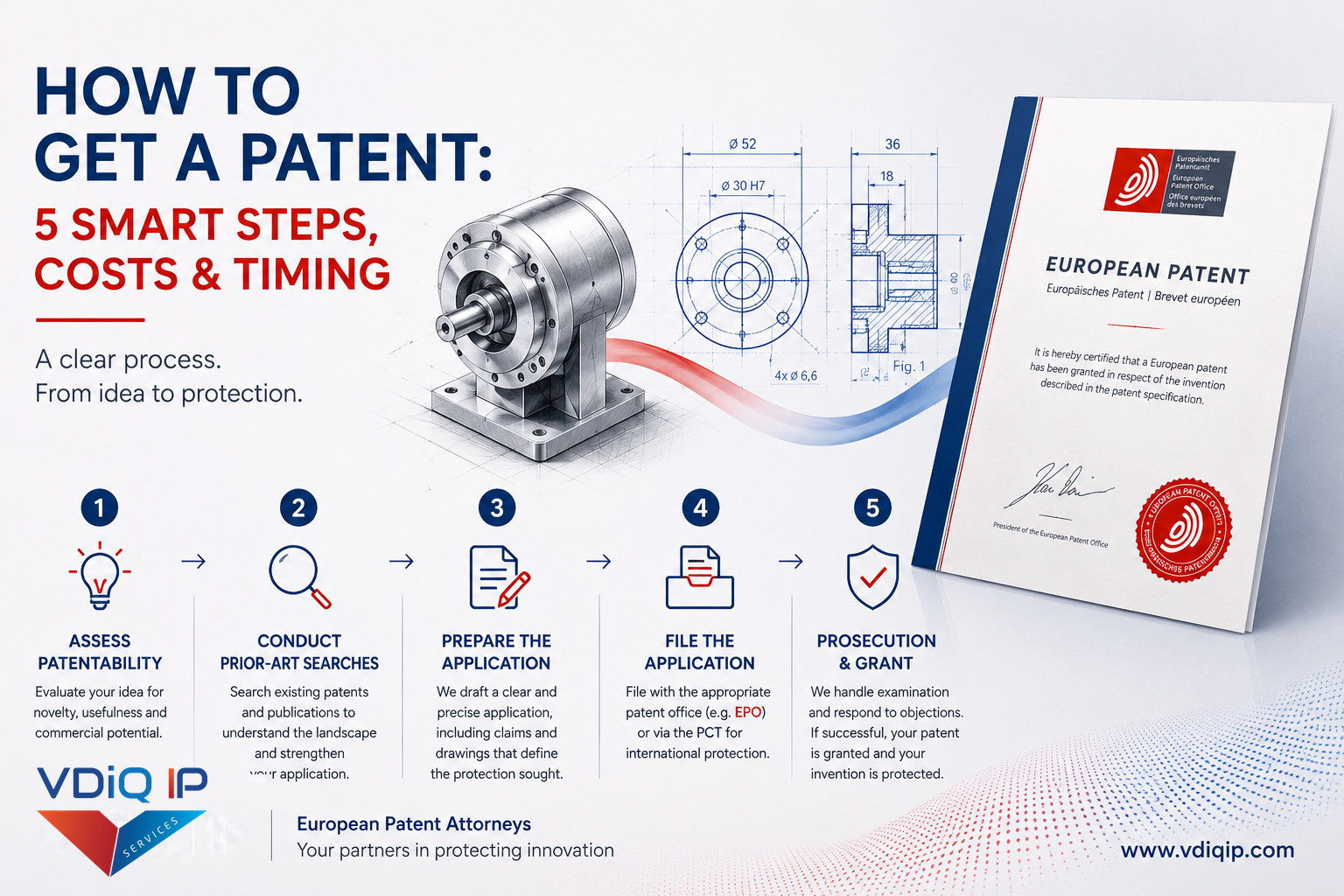
If you have developed a new product, process or technical solution, you may be wondering how to get a patent, how much it will cost and how long the process takes.
You may also be asking: “Can I patent my idea?” Strictly speaking, patents do not protect abstract ideas. They protect inventions – practical technical solutions that satisfy the legal requirements for patentability.
How to Get a Patent in 5 Steps
1
Invention
2
Patent search
3
Patent application
4
Examination
5
Patent
1. Check whether your invention may be patentable
For a European patent, the invention must be technical in character and, among other things, new, inventive and capable of industrial application.
| NEW The claimed invention must not already form part of the prior art. | INVENTIVE It must not be an obvious development for a skilled person. | USEFUL It must be capable of industrial application. |
| Patent tip: If patent protection may be important, avoid making the invention public before filing. A website, trade fair, sale, presentation or other public disclosure can potentially destroy novelty. |
2. Find out what already exists
Before filing, it is often useful to investigate earlier patents, publications and other publicly available technical information. This is commonly called a prior-art search.
The purpose is not merely to find out whether somebody has invented exactly the same thing. A search can also help identify which features distinguish your invention from what was already known – and therefore where valuable patent protection may lie.
| Key question: What is technically new about your invention? |
3. Prepare the patent application
A patent application is both a technical document and a legal instrument. It normally contains a description of the invention, one or more claims, and drawings where appropriate.
| DESCRIPTION Explains the invention and how it can be carried out. | DRAWINGS Show relevant technical features where useful. | CLAIMS Define the legal scope of protection being requested. |
A well-drafted patent application should therefore be prepared with both the technical invention and the applicant’s commercial objectives in mind.
4. File the patent application
Once the application has been prepared, it is filed with the relevant patent office. The filing date can be critical, because later publications or patent filings by others may affect what protection remains available.
Patents are territorial. If protection is required in several countries, the filing strategy may involve national applications, a European patent application or an international application under the Patent Cooperation Treaty (PCT). The PCT does not create a “worldwide patent”; it provides a common filing route that can preserve options in many countries.
5. How long does it take to get a patent?
A patent is rarely granted quickly. After filing, the patent office will normally search the application and then examine whether the claimed invention meets the legal requirements.
For a European patent application, the European Patent Office currently indicates that the grant procedure typically takes around three to five years. Individual cases can be faster or slower. Importantly, the application establishes a filing date while the examination process continues.
| Typical European route: Filing -> Search -> Examination -> Grant |
6. How much does a patent cost?
There is no single fixed price for obtaining a patent. The total cost depends on the complexity of the invention, the amount of drafting work required, official patent-office fees, the course of examination, the countries in which protection is pursued and possible translation costs.
For context, the EPO currently states that the official filing and search fees for a European patent application start at about EUR 1,600. Professional fees for drafting and prosecution, and later official fees, are additional. Patenting is therefore best viewed as a staged investment rather than a one-off purchase.
The more useful commercial question is often not simply “What does a patent cost?” but “Where will patent protection create value?” A focused filing strategy can concentrate expenditure on the technology and markets that matter most.
| Thinking about patenting an invention? VDiQ IP Services assists inventors and businesses with evaluating inventions, patent searches, filing strategies and drafting patent applications with the commercial objective in mind. –> Discuss your invention with a patent attorney |
Frequently Asked Questions About Patents
Can I patent an idea?
Not an abstract idea by itself. Patent protection is directed to an invention – typically a practical technical solution that is new and inventive. The important first step is to turn the idea into a sufficiently developed technical concept.
Can I get a worldwide patent?
No single patent automatically covers the whole world. Patent rights are territorial. The PCT system can simplify the initial international filing process and preserve the option of pursuing protection in many countries, but patents are ultimately granted by national or regional patent offices.
Should I file a patent before showing the invention to investors or customers?
As a general rule, filing before any public disclosure is the safest approach. Confidential discussions under an appropriate non-disclosure agreement may reduce risk, but the patent strategy should ideally be considered before disclosure takes place.
How long does a patent last?
A European patent can generally remain in force for up to 20 years from the filing date, provided the required renewal fees are paid. Some specialised rights may be subject to different rules.
Do I need a patent attorney?
Representation requirements depend on the patent office and the applicant. Even where professional representation is not mandatory, patent drafting and prosecution are specialist tasks because the wording of the claims can determine the commercial scope of protection.
What should I do first if I think I have a patentable invention?
Keep the invention confidential, record how it works and what makes it different, and obtain an early assessment of patentability and filing strategy. Early planning can prevent disclosures or commercial decisions from limiting your options later.
Indicative European timing and EPO fee figures checked against EPO information in September 2026. Official fees and processing times can change.