From 1 April 2027, electronic filing and notification will become the general rule at the European Patent Office. New safeguards aim to protect applicants when technical failures or exceptional events interfere with procedural deadlines. But how far does that protection extend?
A new chapter in European patent practice
The EPO goes fully digital on 1 April 2027, completing its transition to a fully digital patent granting process.
For many patent professionals, electronic filing and communication have long been standard practice. Nevertheless, this transition represents an important legal milestone: electronic communication will no longer merely be the preferred option, but the mandatory standard, subject to limited exceptions.
The changes concern European patent applications and relevant proceedings under the Patent Cooperation Treaty (PCT) and the Unitary Patent system.
An important question arises: What happens when compliance with a procedural deadline becomes impossible because the necessary technology is unavailable?
The EPO has addressed this question through amendments to Rule 134 EPC and accompanying implementing measures.
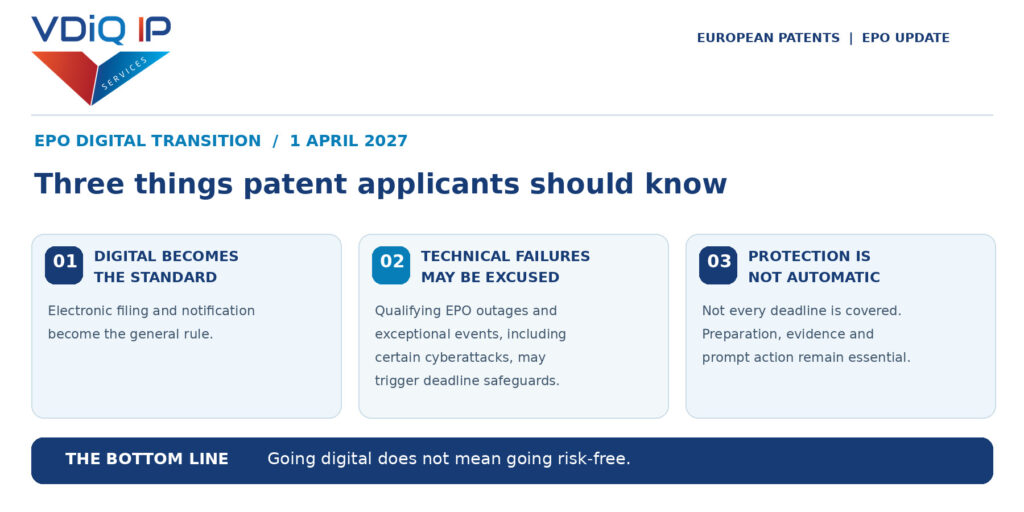
Three things patent applicants should know
1. Digital becomes the standard. Electronic filing and notification become mandatory as the general rule from 1 April 2027.
2. Technical failures may be excused. EPO system outages and exceptional events, including certain cyberattacks, may trigger safeguards against missed deadlines.
3. Protection is not automatic. Not every deadline is covered. Preparation, evidence and prompt action remain essential.
The bottom line: Going digital does not mean going risk-free.
When EPO online services are unavailable
Under amended Rule 134(2) EPC, a qualifying period expiring on a day when an authorised means of electronic communication is unavailable is extended to the first subsequent day on which all such means are available again.
According to the new implementing decision, an electronic communication service is considered unavailable when it cannot be accessed or used for reasons attributable to the EPO.
However, an important exception applies to scheduled maintenance. Where maintenance is announced at least two working days in advance and lasts less than four hours on a working day, the affected service is nevertheless considered available for the purposes of the safeguard.
This distinction underlines the importance of monitoring announced maintenance and planning electronic submissions accordingly.
What if the problem is outside the EPO?
Technical problems do not always originate at the Patent Office.
A natural disaster, major power failure or interruption of internet services may prevent an applicant or professional representative from performing a required procedural act.
Amended Rule 134(6) EPC provides a safeguard for qualifying exceptional occurrences affecting the locality where a party or its representative resides or has its place of business.
Under the new implementing provisions, an omitted action must be performed no later than five days after the affected party or representative ceases to be affected by the exceptional occurrence.
The circumstances must normally be substantiated by appropriate evidence.
Cyberattacks receive particular recognition
One particularly noteworthy development concerns cyberattacks.
Unlike general interruptions of electronic communication, which ordinarily affect a wider geographical area, cyberattacks may qualify as exceptional occurrences even when they affect only a limited number of individuals or organisations.
This is a significant recognition of the realities of modern professional practice.
A ransomware attack affecting a patent attorney’s IT infrastructure, for example, could potentially prevent timely access to documents, electronic filing systems or other essential resources.
The new provisions recognise that such an incident may justify the application of Rule 134(6) EPC, provided the relevant legal conditions are satisfied.
Importantly, the protection is not automatic. The affected party must normally demonstrate that the cyberattack prevented the required action and provide appropriate evidence of the circumstances and their duration.
Not every deadline is protected
Although the new safeguards strengthen legal certainty, their scope should not be overstated.
Rule 134 EPC applies to procedural periods within the meaning of Article 120 EPC. It does not necessarily extend to procedural acts governed by other conditions, such as the filing of a divisional application.
Furthermore, the safeguards do not provide an earlier filing date than the date on which the relevant application was actually received.
Applicants and representatives should therefore continue to distinguish carefully between ordinary procedural deadlines, filing-date requirements and other time-sensitive legal conditions.
What does this mean for your patent portfolio?
For companies relying on external patent attorneys, the transition may require relatively little change to their everyday activities. Their representatives will generally handle electronic filings and monitor official communications.
Nevertheless, clients should ensure that instructions and essential documents reach their representatives sufficiently early, particularly when an important filing deadline is approaching.
Companies managing their own patent procedures should review their electronic filing arrangements, MyEPO Mailbox access, notification monitoring and contingency procedures.
In either case, it is important to understand that an ordinary internal IT failure does not necessarily qualify for relief under Rule 134 EPC.
Where an exceptional incident occurs, organisations should preserve evidence of its cause, duration and practical impact on the ability to meet the relevant deadline.
The EPO’s outage information and available contingency filing arrangements should form part of this preparation.
Digitalisation and legal certainty must go hand in hand
The EPO goes fully digital in 2027, marking an important step in the modernisation of European patent administration.
Digitalisation offers clear benefits in efficiency, accessibility and the speed of communication. At the same time, increasing reliance on electronic systems creates new operational risks.
The amendments to Rule 134 EPC represent an important effort to balance these considerations.
For applicants, patent proprietors and their professional representatives, the central message is straightforward:
Your patent rights should not depend on whether an IT system happens to work on the day of a deadline. But the new safeguards are not a substitute for proper preparation.
At VDiQ IP Services, we follow developments in European patent law and practice closely, helping clients navigate both the legal and practical aspects of protecting their innovations.
Sources: European Patent Office, announcement of 2 November 2026; OJ EPO 2026, A50 and A51.